
How much gum showing when you smile is considered too much
A commonly cited threshold is around three to four millimetres of gum visible above the upper front teeth during a full smile. Above that, a smile is more often described as gummy. That figure is less useful than it sounds. Studies have found dentists tend to notice gum display at smaller amounts than the general public does. Around two millimetres is generally seen as within the normal range.
So the clinical threshold and the point at which anyone actually comments are not the same thing. Gum display also changes across a lifetime. The upper lip gradually lengthens and drops with age, so the same person tends to show less gum at fifty than at twenty without any treatment at all. The practical test is simpler than the measurement. If it bothers you, it is worth assessing. If it does not, there is nothing to correct.
What causes a gummy smile, and what each cause responds to
There are five common causes, and the treatment follows directly from which one you have.
The gum never finished receding. Gum tissue is meant to settle gradually to its adult position on the tooth during development. Where that stops short, the teeth are a normal length but partly buried, so they look square and short.
This is altered passive eruption. Reshaping the gum, sometimes with a small amount of the bone beneath it, exposes the tooth that was always there.
The upper jaw grew vertically long. Here the gums and teeth are normal and the middle third of the face is simply taller than average. Correcting the cause means repositioning the jaw surgically alongside orthodontic treatment. It is a major procedure, and not everyone wants to go ahead with it.
The upper lip is short, or travels too far. Some lips rise further than average between rest and a full smile, exposing gum that stays hidden at rest. A surgical procedure that limits how far the lip lifts can reduce this, although some relapse is possible.
Non-surgical options also exist, and suitability is discussed at a consultation.
The front teeth have over-erupted. Upper front teeth that have drifted downwards bring gum and bone with them. This can follow front teeth wearing down, where teeth compensate for lost height, and moving them back up orthodontically takes the gum line with them. A deep bite, where the upper front teeth overlap the lower ones too far, can contribute in the same way.
The gum tissue has enlarged. Several blood pressure, anti-seizure and immunosuppressant medications list gum overgrowth as a known side effect, and inflammation produces the same thing on a smaller scale.
That is why gum disease treatment and a medication review with your doctor come before any decision about reshaping.
Why gum contouring is not the right gummy smile treatment for everyone
Gum contouring works well where gum tissue is the cause. Where the cause sits in the jaw, published work on treating excessive gum display notes that periodontal surgery alone is generally not sufficient for moderate or severe vertical maxillary excess.
Reshaping gum on a long jaw produces longer teeth and a gum line that is still high. Bone removed during reshaping does not grow back, so the result is hard to undo. Some people also have more than one cause. A short lip can sit alongside altered passive eruption, and wear can sit alongside over-eruption.
Where both are present, treating one and expecting the appearance to resolve usually disappoints. None of this makes gum contouring a poor treatment. It makes it a treatment with a specific indication, which is a different thing.
Where teeth look short because they are worn or naturally small, rather than covered by gum, removing gum only exposes more short tooth. Building the teeth up with bonding, veneers or crowns may then form part of the plan.
When excessive gum display needs a specialist referral
Several of these routes sit outside general dental practice.
Jaw repositioning is planned jointly by an orthodontist and an oral and maxillofacial surgeon, and often runs as a staged process over eighteen months or more.
Lip repositioning surgery and more extensive periodontal procedures are commonly handled by periodontists, each of whom will want the cause settled before they begin.
The person who diagnoses the cause is not always the person who treats it, and the diagnosis is the part that carries the most weight.
What an assessment for excessive gum display involves
Photographs taken at rest, while speaking and during a full smile. Gum display differs across all three, and a posed photograph is the least informative of them.
A measurement of upper lip length and of how far the lip travels from rest to full smile. That is what separates a lip cause from a gum or jaw cause.
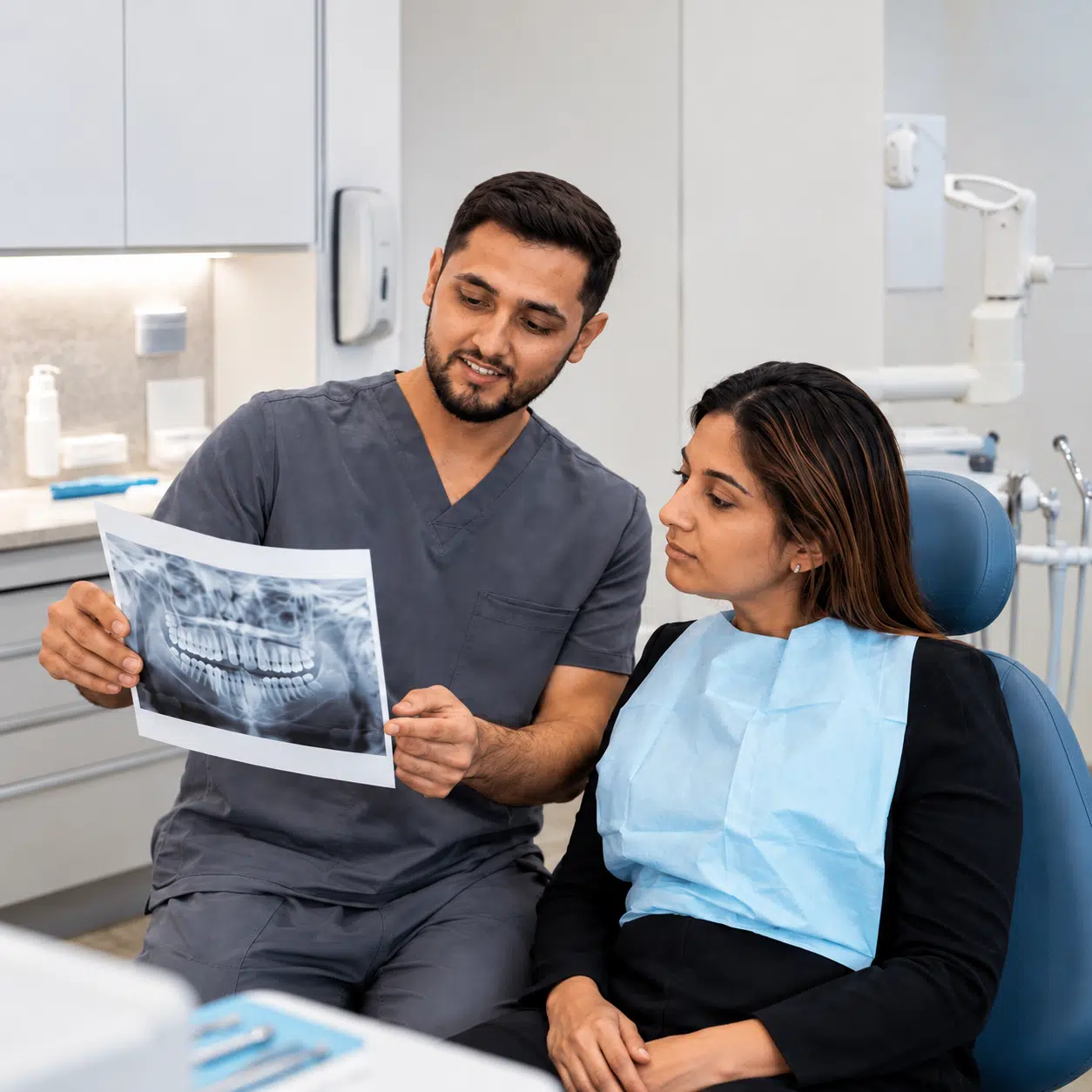
An examination of the gum margins and how much tooth sits beneath them, with radiographs showing where the bone crest sits. That distinction is what identifies altered passive eruption rather than guessing at it.
Where facial proportion appears to be a factor, a lateral cephalometric radiograph may be arranged to assess it properly rather than by eye, along with a review of your medications and medical history.
Hayat Dental is a dentist in Sydney on Broadway in Chippendale. An assessment establishes which of these causes applies before any treatment is discussed, and where correction sits outside general practice we will say so and refer.
Individual results vary, and suitability can only be determined after an examination.
Frequently Asked Questions
Does a gummy smile cause any health problems?
Usually not. The exception is enlarged gum tissue, which creates deeper pockets that are harder to clean and tend to hold plaque, so that version has a health dimension as well as an appearance one.
Is a gummy smile genetic?
Often, in part. Jaw proportion and upper lip length are both inherited traits, and one form of gum overgrowth runs in families. That does not make it untreatable, but it does explain why it often appears across several family members.
Are the results permanent?
It depends on the treatment. Surgical gum reshaping is generally long-lasting and cannot be undone, although some gum rebound can occur. Injectable options are temporary and need repeating, and orthodontic correction needs retention afterwards as all tooth movement does.
Can veneers fix a gummy smile?
Veneers change the shape and surface of teeth, not where the gum sits. On teeth that look short because gum covers them, veneers alone can make the proportions look worse rather than better.
Can braces or clear aligners help a gummy smile?
Sometimes. Where over-erupted front teeth or a deep bite are part of the cause, orthodontic treatment can move the teeth and gum line upwards. It does not change a short lip or a long upper jaw on its own.
Is gum contouring painful?
It is carried out under local anaesthetic, so the procedure itself should not be painful. Soreness and some swelling for several days afterwards is normal, and the gum takes a few weeks to settle into its final position. That settling is why the result should not be judged straight away.
What affects the cost of treating a gummy smile?
It depends on the cause and the treatment involved. A simple gum reshape, orthodontic treatment and jaw surgery sit at very different levels, and some cases combine more than one. A written cost is given once the cause has been diagnosed.



Written by the Hayat Dental team
Dr Abhishek Aggarwal, Dr Joanne McGilp and Masi Hashimi care for patients at our Broadway clinic in Chippendale.
Meet the teamThis article is general information only and is not a substitute for a dental assessment. If you have pain or swelling, call the clinic.